
Under Climate Active guidelines, entities report their electricity emissions using two methods (dual reporting). However, they must choose one approach as their primary reporting method to determine their carbon neutrality requirements. Trellis has introduced a Market vs. Location-Based Reporting feature to better align with this electricity accounting framework.
Location – Based
-
-
This approach calculates emissions using regional grid electricity emission factors, reflecting the actual mix of electricity generation in a specific state or territory.
-
Inputs: Grid electricity consumption (kWh), State or regional greenhouse gas (GHG) emissions factors.
-
Market – Based
-
-
This approach reflects electricity procurement decisions by allowing businesses to account for renewable energy purchases and contractual electricity arrangements. A single national factor is used for acquitting emissions that can be related to use of renewable electricity.
-
Inputs: Grid electricity consumption (kWh), Renewable Power Percentage (RPP), Quantity of renewables (kWh).
-
Note: For both Location-Based and Market-Based reporting, we use the relevant emission factors from the National Greenhouse Accounts (NGA) Factors. For Market-Based Reporting, there is an additional input in the form of the Renewable Power Percentage (RPP), which is published by the Clean Energy Regulator. Both the NGA factors and RPP are publicly available.
How Trellis Handles Different Reporting Methodologies
The table below compares Trellis's reporting approaches, highlighting emissions calculations, the role of renewables, and Climate Active compliance.
|
Category |
Default |
Location-Based |
Market-Based |
|
Climate Active Compliance |
Not compliant |
Compliant |
Compliant |
|
Emissions Calculation |
Uses state or regional grid emission factors and includes offsets related to renewable electricity. |
Uses state or regional grid emission factors only. |
Uses a national emissions factor and RPP. |
|
Greenpower / Renewables |
Greenpower offsets are included, but this approach is not compliant with Climate Active. |
Renewables have no impact on emissions calculations in this instance. |
Renewable electricity is included and has impact on emissions calculations. |
|
Use Case |
Businesses see emissions based on their location but also with Greenpower reductions applied. |
Helps businesses communicate their environmental footprint based on their region. |
Helps businesses communicate their environmental footprint based on their choices to buy accredited renewable electricity rather than just their regional footprint. |
Location – Based Calculation
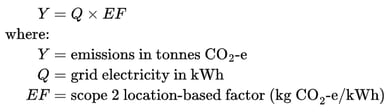
In the Location-Based approach, emissions are calculated based on state or regional electricity grid emission factors. The related emissions factors already account for any underlying renewable electricity offsets like Greenpower. For this reason, this approach does not allow the latter to be used to reduce emissions.
Scope 2 emissions (Y) = Quantity of electricity (Q) x Emissions Factor (EF)
Worked Example
A business in South Australia (SA) consumes 1,000 kWh in FY2025, for which the scope 2 emission factor is 0.00023 tonnes CO₂-e/kWh and the related scope 3 is 0.00005 tonnes CO₂-e/kWh.
The emissions are therefore:



Market – Based Calculation
Emissions are calculated based on additional information:
-
Mandatory Large-Scale Renewable Energy Target (Mandatory LRET): The portion of grid electricity consumption (in kWh) that corresponds to the Renewable Power Percentage (RPP):

Note: The RPP is updated annually by Australian government and reflects the share of zero-emission electricity in the grid.
The Renewable Energy Target (RET) is government scheme administered by the Clean Energy Regulator that aims to reduce emissions from the electricity sector. The scheme was initiated in 2020 and will run until 2030.
The above is used to calculate the Residual Electricity for which GHG emissions are liable.
-
Residual Electricity: The remaining electricity after deducting Greenpower (in kWh) and mandatory LRET (in kWh) from total grid consumption:

Note: Greenpower and other renewables modify the electricity subject to emissions but have has no direct emissions impact.
Worked Example
Here is a worked example for a South Australian facility with total FY2025 electricity consumption of 1,000 kWh and a 50% Greenpower usage.
The scope 2 market-based emissions factor is s 0.00081 tonnes CO₂-e/kWh, the related scope 3 is 0.00011 tonnes CO₂-e/kWh and the annual RPP factor is estimated at 17.91%.




Potential Issue with 100% Greenpower:
If a business purchases 100% Greenpower (or indeed anything above around 80%, which accounts for 100% Greenpower – see below), the calculation for Residual Electricity related emissions will become negative. This issue arises because Market-Based Reporting as calculated by Climate Active adjusts for RPP and applies Greenpower deductions based on the total grid electricity, whereas the latter would appear to be better used as a percentage of the residual. Otherwise, this appears to be a double-counting effect. In such instances these emissions should be reported as Zero as emissions reductions related to renewable electricity can only go to zero rather than contribute to other sources.
Worked Example (100% Greenpower)

When multiplied by the related factor the result is therefore negative.
Since residual electricity cannot be negative, it is adjusted to zero:

Additional Sources
Climate Active – Electricity Accounting
https://www.climateactive.org.au/sites/default/files/2023-08/Climate-Active-Electricity-Accounting%20-%20PDF.pdf, Accessed February 2025
Australian National Greenhouse Accounts Factors https://www.dcceew.gov.au/sites/default/files/documents/national-greenhouse-account-factors-2024.pdf, Accessed February 2025
Clean Energy Regulator Renewable Power Percentage
https://cer.gov.au/schemes/renewable-energy-target/renewable-energy-target-liability-and-exemptions/renewable-power-percentage , Accessed February 2025