
The basic components of Trellis are structured hierarchically. These components include:
-
Inventories - The highest level in the data structure, an inventory typically contains all data belonging to an organisation. Only data in the current active inventory are displayed and reported on.
-
Facility groups - Inventories may contain multiple facility groups. Facility groups organise facilities into categories for reporting purposes. For example, a facility group may represent a business unit or geographical division.
-
Facilities- Facility groups may contain multiple facilities. Facilities represent physical sites and may be positioned on a map.
-
Meters - Facilities may contain multiple meters. Meters are unique identifiers used to group source data. Among other things, meters may represent a National Meter Identifier (NMI) for electricity, a Meter Identification Reference Number (MIRN) for natural gas, or the location of a rubbish bin.
-
Source data - Meters may contain any number of source data points. Source data points represent a line item extracted from a bill, a figure from a report, or other data source. Source data points can record cost, resource consumption, the applicable emissions factor, and other relevant information.
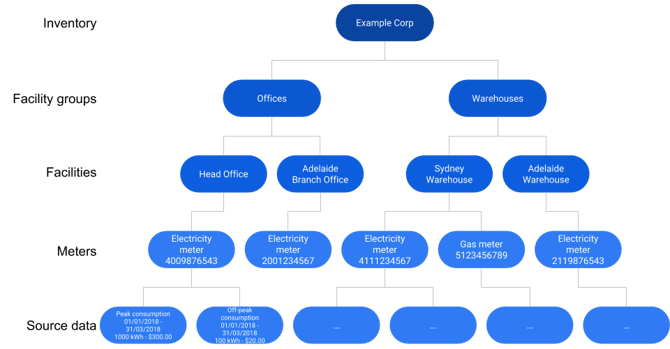
The below diagram illustrates how the Trellis structure could be set up for an organisation with multiple offices and warehouses, each of which has one or more electricity and gas meters.
Note: This specific example only shows electricity and gas meters but any facility can have any combination of resources.
Next Steps
-
Learn how to explore data by drilling down through the hierarchy using the dashboard.
-
Report on data in more detail by customising reports.