
Facilities may contain multiple meters. Meters are unique identifiers used to group source data. They commonly represent a National Meter Identifier (NMI) for electricity, a Meter Identification Reference Number (MIRN) for natural gas, or the location of a rubbish bin.
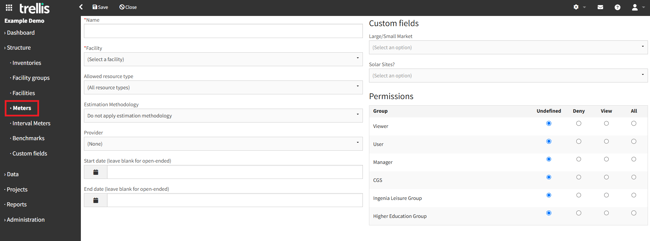
Meters have the following properties:
-
Name - Used to match source data read by Trellis to the meter. Meters with duplicate names may not be valid for overlapping periods. Typical meter names include:
-
National Meter Identifiers (NMIs) for electricity meters.
-
Meter Installation Registration Numbers (MIRNs) for gas meters.
-
Car registration numbers for fuel cards.
-
Note: Meter names are used as unique identifiers for bill matching - these must be kept consistent and unique to maintain data integrity. If you are unsure, please contact support.
-
Facility - The facility to which the meter belongs.
-
Allowed resource type (optional) - If set, prevents the allocation of source data for other resource types to this meter.
-
Provider (optional) - Organisation providing the source data to be attached to the meter. Individual source data records are linked to a provider, so this field is optional, but can be provided in order to specify a provider even for meters where no data has been received.
-
Start date (optional) - Date this meter became active; open-ended if left blank. If a start date is set, the period before that date will not be flagged as having missing data.
-
End date (optional) - Date this meter stopped being active; open-ended if left blank. If an end date is set, the period after that date will not be flagged as having missing data.
Next Steps
-
Meters belong to facilities. Read more about facilities.
-
Meters may contain any number of source data points. Read more about source data.
-
Need to add or edit meter details? Read about how to add or edit data records.
-
Need to add a number of meters at once? Read about importing data in bulk.